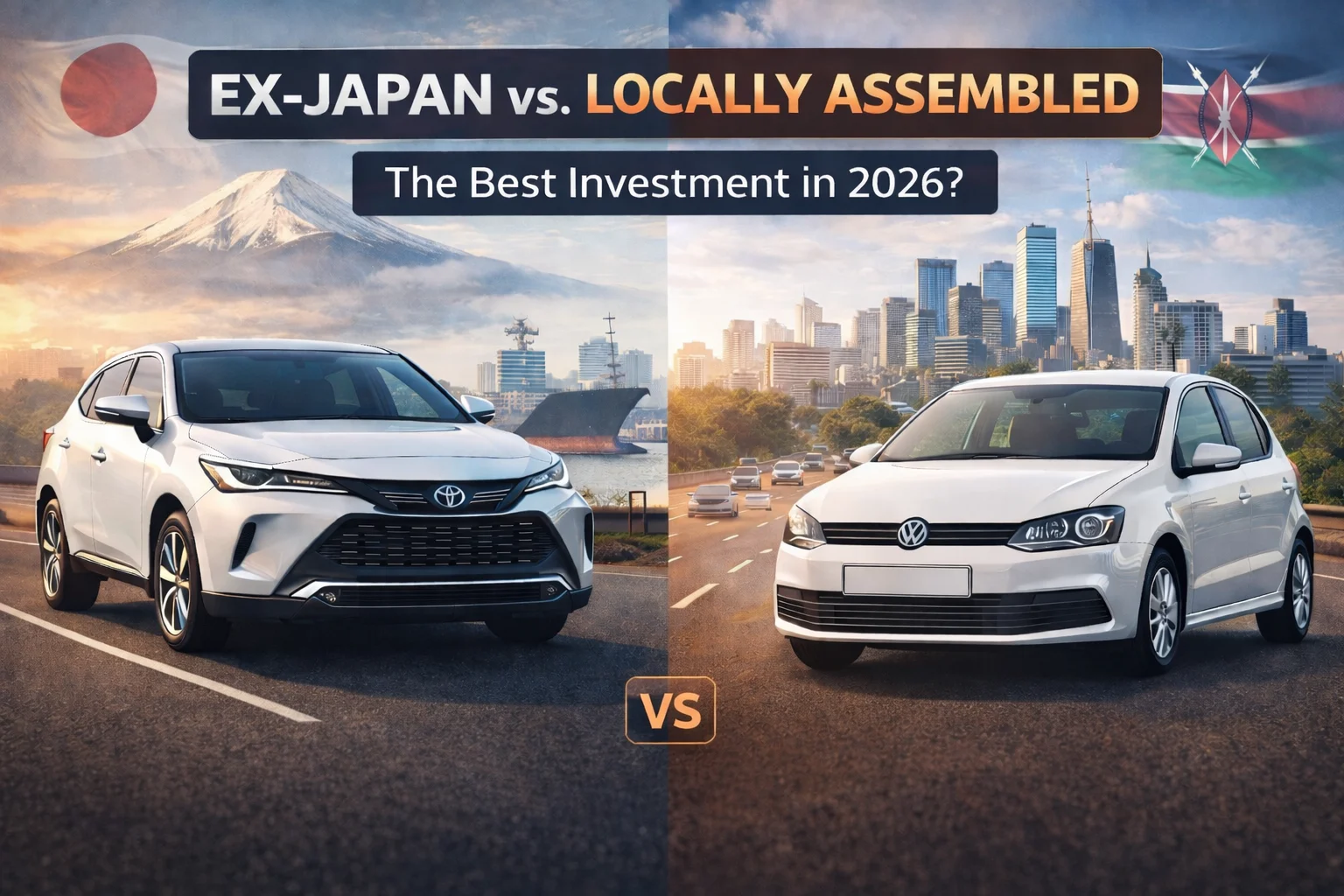
EX-Japan vs. Locally Assembled — this is the question every serious Kenyan car buyer is asking in 2026. With new government incentives making locally assembled vehicles more affordable, and high-spec EX-Japan imports still dominating the roads, choosing between the two has become less about price and more about value, durability, and long-term investment.
Walk into any major showroom in Nairobi today and you’ll likely see the banner:
“Buy Kenya, Build Kenya.”
With the 2026 government tax incentives, locally assembled models like the Volkswagen Polo Vivo, Proton Saga, and Isuzu mu-X are now more affordable than ever.
But here’s the real question serious buyers are asking:
When comparing EX-Japan vs. Locally Assembled, which one is actually the smarter investment?
Let’s break it down clearly.
1. The Specs Gap: Base Model vs. High Spec
The biggest shock many buyers experience when choosing Locally Assembled vehicles is what we call the “Base Model Reality.”
To keep prices competitive (typically between KSh 2.5M – 3.5M), local assemblers often strip down specifications.
The Locally Assembled Experience (2026)
In this price range, you are typically getting:
Manual seats (no electric adjustment)
Entry-level halogen headlights
Basic safety features (ABS, airbags)
Plastic interior trims
Standard infotainment system
Now compare that to a similarly priced EX-Japan high-spec model from 2018–2019.
For roughly the same KSh 3M budget, an EX-Japan import might offer:
Electric leather seats
LED or adaptive headlights
Advanced driver assistance systems
360° camera
Premium infotainment
Panoramic sunroof
When evaluating EX-Japan vs. Locally Assembled, the specification gap is often the first major difference buyers notice.
Locally assembled cars focus on affordability. EX-Japan models focus on features and refinement.
2. Durability: Japanese Roads vs. Kenyan Assembly
There’s a popular saying among mechanics in Nairobi:
“A car that has done 50,000km in Japan is fresher than a car that has done 5,000km in Kenya.”
It sounds dramatic — but there’s logic behind it.
EX-Japan Advantage
A vehicle manufactured in Japan for the domestic market (JDM) is built to extremely high standards. It typically:
Has detailed service history
Was driven on smooth highways
Faced minimal traffic stress
Experienced consistent maintenance
Japanese factories are globally recognized for precision engineering and strict quality control.
Locally Assembled Reality
Locally assembled units are designed to suit Kenyan roads, sometimes with reinforced suspension.
However, many are “global budget models” — engineered to meet price targets rather than premium driving feel.
So in the debate of EX-Japan vs. Locally Assembled, durability often leans toward the EX-Japan side, especially when considering long-term ownership comfort.
3. The 3-Million-Shilling Question
Let’s talk numbers — because this is where most decisions are made.
Here’s how your KSh 3M budget works in 2026:
Feature
Locally Assembled (Brand New 2026)
2019 High-Spec EX-Japan
Price
KSh 2.8M – 3.4M
KSh 2.9M – 3.5M
Mileage
0 km
40,000 – 60,000 km
Warranty
2–3 Years Local
Importer-backed / Optional warranty
Specs
Base Trim
High-Spec Premium
The key question becomes:
Do you want zero mileage with basic features, or moderate mileage with premium specifications?
In the EX-Japan vs. Locally Assembled comparison, the difference is not about new vs. used — it’s about value vs. features.
4. Resale Value: The “Hustler” Logic
In Kenya, we don’t just buy a car for today.
We buy it for the next buyer.
Resale value matters.
EX-Japan Resale Strength
Imported Toyotas and Mazdas hold value like land in Kamulu.
Because EX-Japan units often come with:
Higher specifications
Better brand perception
Strong demand in the second-hand market
They remain desirable years later.
If you spend KSh 3M today on a 2019 Toyota Harrier EX-Japan, it may still command around KSh 2M after three years.
Locally Assembled Depreciation
Locally assembled budget models may depreciate faster.
Why?
Because the next buyer compares features — and high-spec EX-Japan models usually win.
In a 3-year resale scenario:
EX-Japan might retain stronger value
Locally Assembled base models may struggle to match demand
When analyzing EX-Japan vs. Locally Assembled, resale logic strongly favors EX-Japan for private buyers focused on long-term investment.
5. Why EX-Japan Still Wins in 2026
Let’s be clear:
The government is doing an excellent job promoting local assembly. For:
Corporate fleets
Government tenders
First-time buyers prioritizing warranty
Locally assembled vehicles make sense.
But for the enthusiast…
The person who wants:
A sunroof
Self-steering assist
Adaptive cruise control
Premium leather
A refined driving feel
In the EX-Japan vs. Locally Assembled debate, the 2019 high-spec EX-Japan import is still the undisputed king.