Advantages Of Hybrid Cars
October 6, 2026
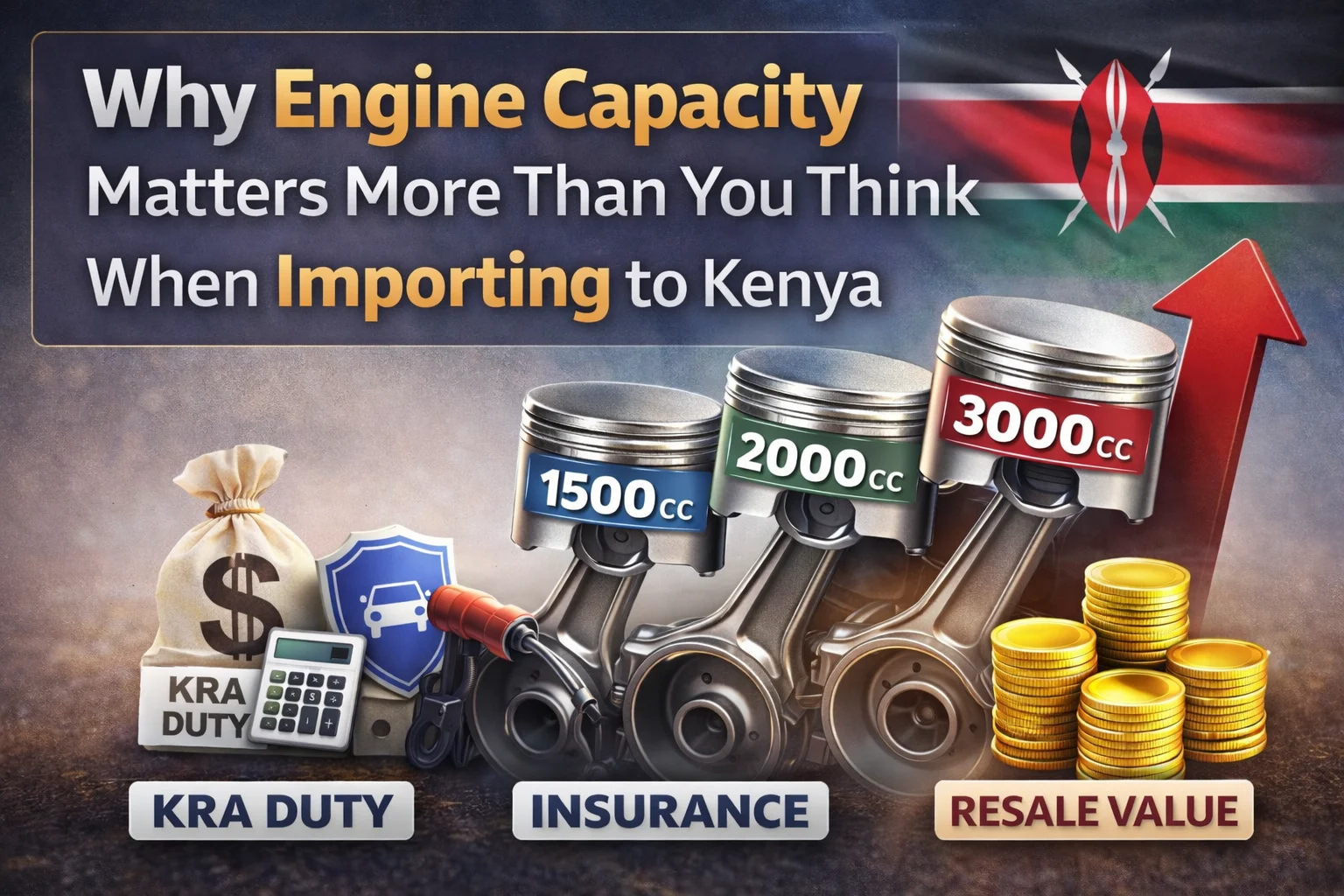
If you’ve ever watched two cars that look almost identical get very different landed costs in Kenya, there’s a good chance the reason is not the colour, not the trim, not even the sunroof. It’s Engine Capacity.
And here’s the part many buyers learn after they’ve already fallen in love with a car online: Engine Capacity quietly affects almost everything—your taxes, your insurance, your fuel budget, and even your resale value.
In the world of imports, Engine Capacity is not just a number on the logbook. It’s the difference between a smart purchase and a “boss, si ni sawa, but the budget is crying” moment.
Engine Capacity (measured in cc, like 1500cc, 2000cc, 2500cc) refers to the total volume of all the cylinders in the engine. In simple terms:
When importing, Engine Capacity becomes a key “money lever” because Kenya’s tax system and ownership expenses react strongly to it.
So yes Engine Capacity matters more than you think when planning imports to Kenya.
Let’s start with the big one: KRA duty impact.
Kenyan vehicle taxes are calculated based on customs value and duty structures that typically punish big engines harder than small ones. Even without going deep into the complicated formulas, the reality on the ground is consistent:
This is why, in many imports, the smartest buyers don’t start by asking “Which car looks best?”
They start by asking: “What Engine Capacity fits my budget?”
Instead of “I want an X5 because it looks good,” a smart importer asks:
Because the truth is: Engine Capacity can increase the landed cost more than you expect.
This is why CarsKenya always advises clients to choose Engine Capacity based on both desire and financial reality especially for first-time imports.
Let’s talk about a bill people remember only after they buy the car: insurance.
Insurance pricing is influenced by:
Higher Engine Capacity vehicles tend to be:
So insurers price them accordingly.
That means:
So while Engine Capacity affects duty upfront, it also affects your monthly or annual ownership costs over time.
For many imports, the best decision is not “what can I buy today?” but “what can I comfortably own for the next 3–5 years?”
Now let’s talk about fuel—the daily reality.
In Kenya, your fuel consumption isn’t determined only by the car’s brochure.
It’s determined by:
Generally:
You might love that 2500cc V6, but it will also love your wallet. Aggressively.
And in stop-and-go traffic, higher Engine Capacity engines can feel like they’re drinking fuel out of boredom.
That’s why many modern buyers prefer:
For many imports, choosing Engine Capacity wisely is the difference between “I love my car” and “I love my car but I fear the fuel station.”
Now let’s get serious about the long game: resale.
In Kenya, people don’t just buy a car for themselves. They buy it for the next buyer too. That’s why resale is critical.
Here’s the truth: resale value in Kenya is strongly tied to practicality.
And practicality includes:
Cars with extremely high Engine Capacity can have narrower resale markets because fewer buyers can afford to maintain them. That doesn’t mean they don’t sell it means they sell to a smaller audience.
On the other hand, mid-range Engine Capacity vehicles often enjoy stronger resale because they appeal to more buyers.
So when comparing imports, consider this:
Resale in Kenya is about demand. And demand is about affordability. Engine Capacity affects resale more than many buyers realize.
If you want to import smart, don’t only look at landing cost. Look at total cost of ownership:
Engine Capacity affects every line of that list. So yes Engine Capacity matters more than you think.
The Kenyan market is changing:
That means people are no longer just buying “big engine for status.” They’re buying “smart engine for value.”
And that’s exactly why Engine Capacity is a major conversation in modern imports.
At CarsKenya, we don’t just help you import a car. We help you import the right car.
That means we guide you on:
Because the best imports are not the ones that look good online. The best imports are the ones that make sense today, tomorrow, and when you eventually sell.

Experience a seamless car import service tailored to your needs with CarsKenya – the Home of Car Import Experts.

WhatsApp us